Projects
sustaincrop
The project
SUSTAINCrop Launches to Help Europe Grow a More Sustainable Bio-Based Economy
A new Horizon Europe project, SUSTAINCrop, has launched to help farmers, companies and policymakers make better decisions about crops used in bio-based industries.
As Europe seeks alternatives to fossil-based materials, crops such as rapeseed, sugar beet, hemp and flax are becoming increasingly important sources of renewable raw materials. However, understanding their true environmental impact remains a challenge.
SUSTAINCrop will develop practical tools that make it easier to compare crop production systems and assess their effects on land use, water resources, biodiversity, greenhouse gas emissions and future market opportunities. By providing reliable and comparable information, the project aims to support more sustainable decisions across bio-based value chains.

Dr. Gabor Vicze
Consortium Leader | CEO of innomine
“Many of the materials we use every day could come from renewable crops instead of fossil resources, but that only makes sense if we understand the full environmental picture. SUSTAINCrop will turn complex science into practical guidance, helping farmers, industry and policymakers choose better options. As consortium leader, innomine is proud to coordinate a project that connects digital innovation, trusted data and real cooperation between Europe and Latin America.”
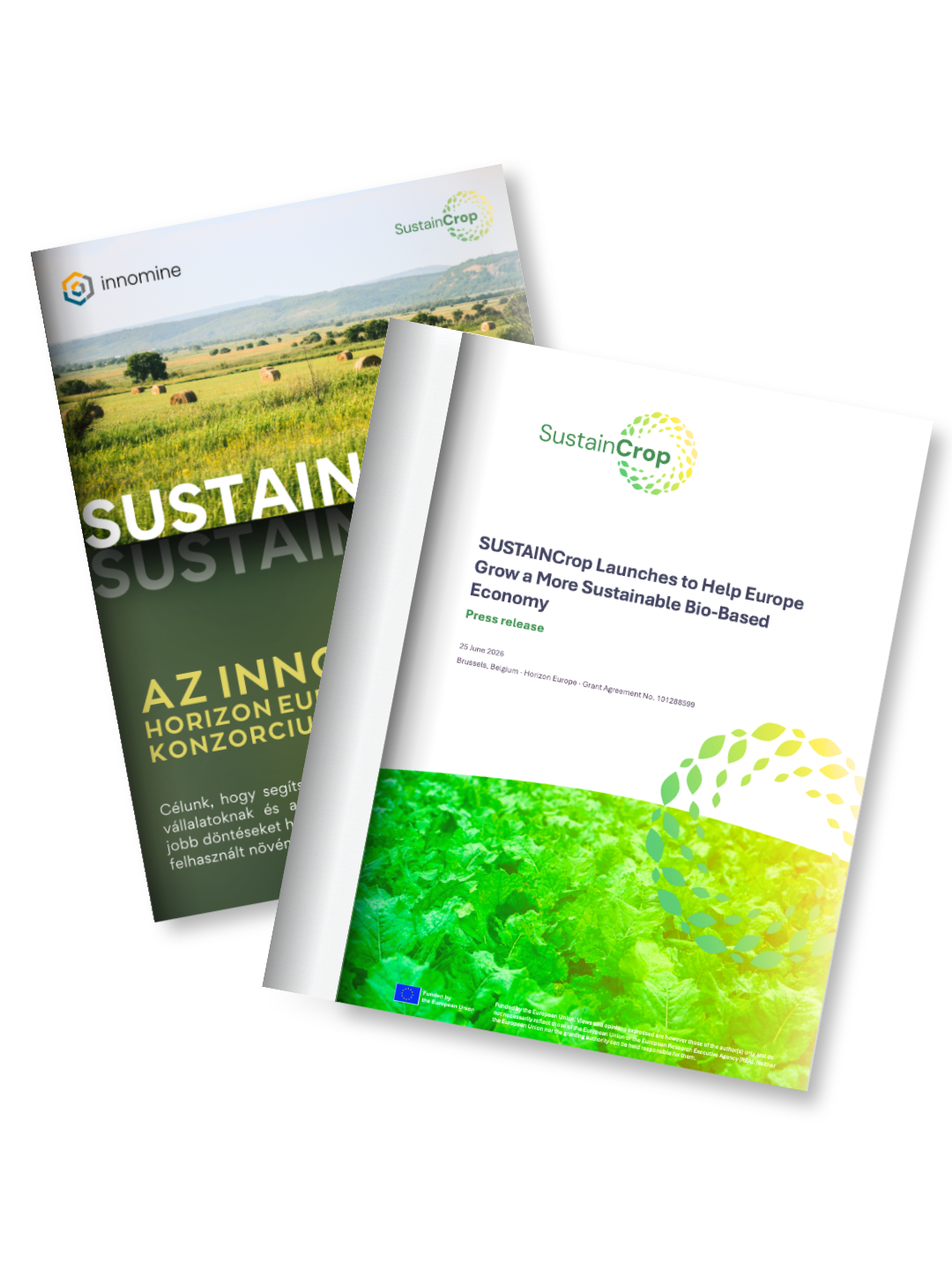
Download the official press release
Learn more about the SUSTAINCrop Horizon Europe project and how it’s gonna help Europe grow a more sustainable bio-based economy.
SUSTAINCrop will support the sustainable expansion of the European bioeconomy by creating a science-based, stakeholder-validated, and policy-relevant framework for assessing and comparing the environmental performance of primary agricultural crops used in bio-based industrial value chains. The project addresses a critical knowledge gap regarding the environmental impacts of crops such as rapeseed, sugar beet, hemp, flax, maize and other industrial feedstocks, whose sustainability performance remains fragmented and insufficiently characterised across regions.
The project will establish an EU reference framework for environmental sustainability criteria of agricultural crops used in bio-based industries. Through Knowledge Exchange Communities (KECs) across Europe and an international KEC covering Latin America and the Caribbean, SUSTAINCrop will bring together farmers, researchers, industry representatives, policymakers, advisors, NGOs, and other stakeholders to co-create, validate and disseminate knowledge on sustainable crop production systems.
SUSTAINCrop will develop a harmonised geo-referenced crop database covering at least 19 crops, a digital modelling framework enhanced with artificial intelligence, and an interactive dashboard for scenario-based environmental impact assessment. These tools will support data-driven decision-making at farm, regional, industrial and policy levels while aligning with Safe and Sustainable by Design (SSbD), Environmental Footprint (EF) methodologies and the EU Taxonomy framework.
As coordinator, innomine will lead the overall project management and coordination while contributing to stakeholder engagement, communication and dissemination activities, knowledge exchange, capacity building, training, exploitation, and the long-term sustainability of project results.
sustaincrop
background
The transition towards a sustainable and circular bioeconomy depends on reliable knowledge about the environmental impacts of crops used as feedstocks for bio-based industries. Europe produces nearly one billion tonnes of agricultural biomass annually, yet significant gaps remain in understanding the environmental trade-offs associated with industrial crops across different regions and production systems. Greenhouse gas emissions, biodiversity impacts, water consumption, nutrient leakage, and land-use change are often poorly quantified and assessed using inconsistent methodologies.
Although bio-based sectors continue to grow, the lack of harmonised, geo-specific data, comparable sustainability criteria, and interoperable assessment tools limits evidence-based policy making, investment decisions, and sustainable crop management. SUSTAINCrop addresses these challenges by providing a common framework, digital tools, and validated sustainability criteria for industrial crop production systems.
Objectives of the project
- Establish and strengthen Knowledge Exchange Communities (KECs) across Europe and Latin America to promote stakeholder engagement, co-creation, peer learning, validation activities, and knowledge exchange among farmers, researchers, industry representatives, advisors, policymakers and civil society organisations.
- Collect, harmonise and integrate geo-referenced data on cultivation systems, agronomic practices and environmental performance for at least 19 industrial crops, creating a common evidence base for sustainability assessment and decision-making.
- Develop and validate the SUSTAINCrop Toolkit, including a harmonised environmental assessment framework, AI-enhanced digital modelling tools, scenario simulations, and an interactive dashboard that supports environmental performance assessment at farm, regional, industrial and policy levels.
- Identify sustainable crop production pathways and generate evidence-based recommendations through environmental impact assessments, validation activities, best-practice development, policy dialogue and stakeholder feedback, supporting the implementation of SSbD, Environmental Footprint and EU Taxonomy principles.
- Communicate, disseminate and transfer project knowledge through training, capacity building and policy engagement, enabling farmers, advisors, industry stakeholders and policymakers to adopt sustainable crop production practices and make informed decisions.
- Embed SUSTAINCrop within European and international bioeconomy ecosystems and ensure the long-term sustainability, exploitation and uptake of project results through integration with EU platforms, policy frameworks, networks and future collaborations.
Approach
SUSTAINCrop follows a phased methodology built around stakeholder engagement, scientific assessment, digital innovation, validation and long-term sustainability.
1. BASELINE AND DATA COLLECTION
Identification and profiling of 19 priority crops, development of a harmonised geo-referenced crop database, and establishment of sustainability indicators and assessment criteria.
2. KNOWLEDGE EXCHANGE AND CO-CREATION
Activation of Knowledge Exchange Communities (KECs) across five European regions and an international KEC in Latin America to facilitate stakeholder engagement, workshops, peer learning, and validation activities.
3. DIGITAL TOOLKIT DEVELOPMENT
Creation of the SUSTAINCrop Toolkit combining Life Cycle Assessment (LCA), spatial modelling, AI and machine learning technologies, geo-referenced datasets, and scenario modelling capabilities.
4. VALIDATION, TRAINING AND UPTAKE
Testing and validation of the toolkit through real-world scenarios, stakeholder consultations, training programmes, workshops, policy dialogues, and capacity-building activities.
5. SUSTAINABILITY AND IMPACT
Integration of project outputs into platforms such as EU FarmBook and CAP Networks, development of long-term exploitation pathways, and support for policy uptake and industry implementation beyond the project’s lifetime.
impact
SUSTAINCrop directly supports the objectives of the European Green Deal, the Zero Pollution Action Plan, the EU Bioeconomy Strategy, Safe and Sustainable by Design principles, the EU Taxonomy framework, and broader climate neutrality goals.
The project is expected to:
- Strengthen the environmental knowledge base for industrial crop production systems.
- Improve sustainability performance and market readiness of bio-based value chains.
- Enable more effective, evidence-based policymaking and investment decisions.
- Increase adoption of sustainable cropping practices by farmers and advisors.
- Support pollution prevention, biodiversity protection, efficient resource use, and climate mitigation.
- Foster collaboration between Europe and Latin America on sustainable biomass production and environmental sustainability standards.
If adopted on 10% of EU arable land used for industrial crops, SUSTAINCrop tools and best practices could contribute to annual greenhouse gas emission reductions of approximately 4 million tonnes CO₂-equivalent, nutrient loss reductions of up to 8%, and water-use efficiency improvements of 10-15% for key crops such as maize and sugar beet.
partners







Let's Work Together!
We are here to help you grow.
Send us a message and let’s change the future.
Contact
(+36) 30 198 2838
11. Széll Kálmán tér, Budapest 1024